
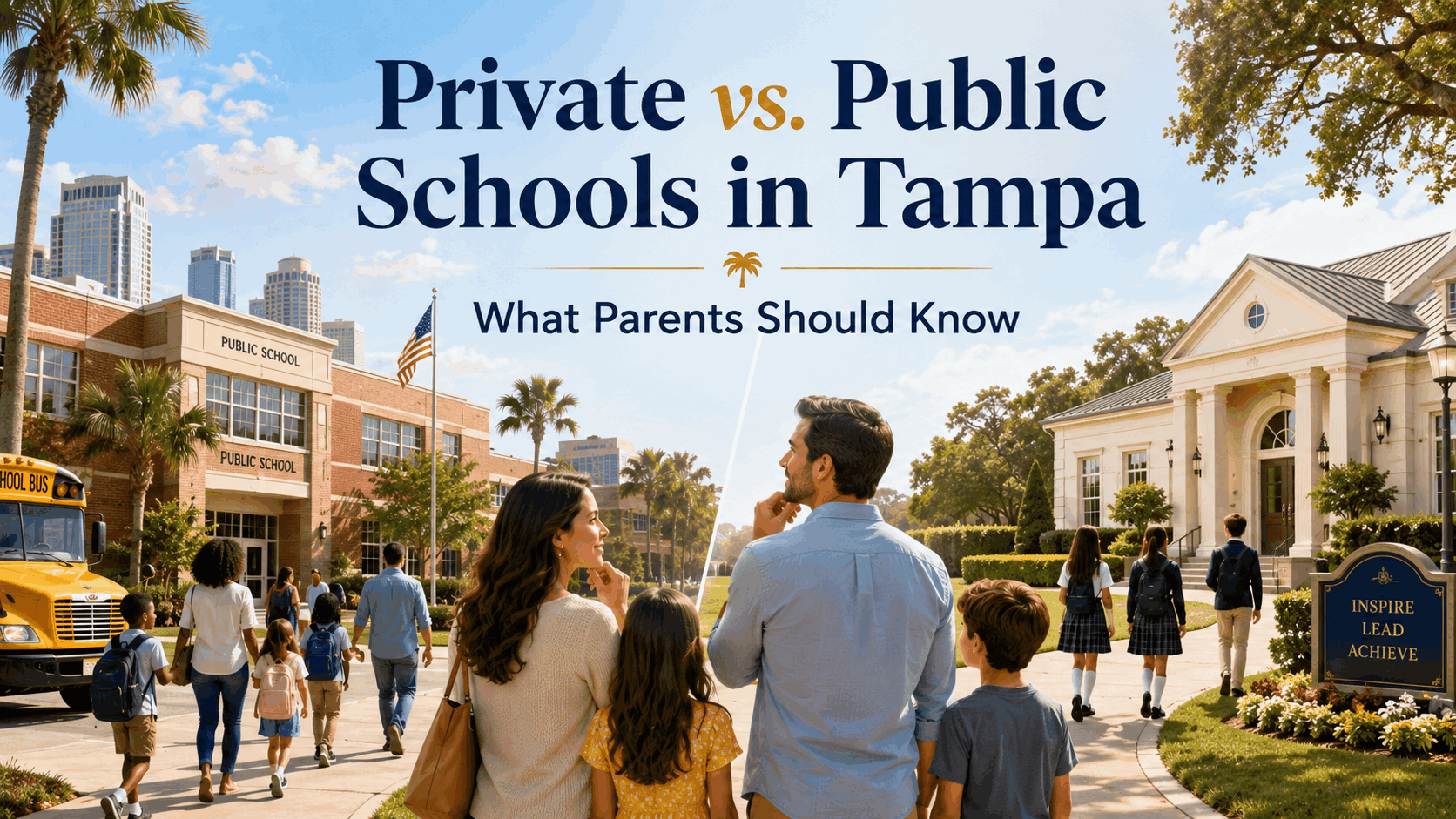
Private vs. Public Schools in Tampa: What Parents Should Know
A practical comparison of tuition, scholarships, admissions, transportation, academics, special education, class size, accountability and the everyday tradeoffs Tampa families should investigate.
Are Private Schools Better Than Public Schools in Tampa?
Not automatically. Tampa has strong public, magnet, charter, religious and independent-school options, and schools within the same category can differ more than the categories themselves. The better school is the one that can meet your child’s academic, social, support, transportation and family-budget needs consistently.
Public schools offer tuition-free access, legal protections, district services, transportation in qualifying situations and a broad range of programs. Private schools may offer a particular educational philosophy, religious environment, smaller campus, specialized culture or different academic structure, but they set their own admissions policies and tuition can extend far beyond the advertised base price.
Florida scholarships have made private education financially accessible to more families. For 2026–27, Step Up For Students describes an average private-school scholarship of about $8,000 for eligible K–12 Florida students. That amount may cover a large share at one school and only part of tuition and fees at another.
Which School Type Should You Explore First?
This tool offers a starting point, not a school recommendation.
Start by comparing your assigned public school, relevant magnet or Choice programs, charter options, and two or three private schools.
In This Guide
Tampa Families Have More Than Two Choices
The phrase “public versus private” hides a much larger menu. A Tampa family may compare:
Hillsborough County Public Schools advertised more than 100 tuition-free magnet and Choice programs for the 2026–27 application cycle. Placement is not guaranteed and depends on eligibility, available seats and lottery selection when applicable.
Private vs. Public Schools in Tampa: Side-by-Side
| Issue | Public School | Private School | What Parents Should Verify |
|---|---|---|---|
| Tuition | No tuition for eligible residents | Tuition and fees vary; scholarships may offset cost | Full annual cost, not only published tuition |
| Admission | Assigned schools must generally serve eligible residents; Choice, magnets and charters use applications | School-specific criteria, records, interviews, testing and capacity | Acceptance timeline, waitlist and reenrollment rules |
| Transportation | May be available based on eligibility and program | Often family responsibility; some schools offer paid routes | Actual door-to-door weekday commute |
| Curriculum | Florida standards and district requirements | School-selected curriculum, subject to applicable law and accreditation choices | Course sequence, textbooks and graduation planning |
| Testing | State assessment and accountability system | Varies; scholarship-participating schools have applicable assessment requirements | Which tests are used and how results are shared |
| Special education | IDEA and Section 504 protections apply | Services and legal framework differ; some specialize, others offer limited support | Written services, staffing, accommodations and cost |
| Class size | Varies by school, subject and grade | Varies widely despite marketing claims | Current grade-level and course-level numbers |
| Religion | Secular public instruction | May be central, occasional or absent | How faith affects curriculum, conduct and participation |
| Accountability | Public reporting, school grades and district oversight | Governance and reporting vary; scholarship rules add requirements for participating schools | Accreditation, governance, outcomes and complaint process |
| Calendar and care | District calendar and school-specific programs | School calendar, holidays and care vary | Teacher workdays, summer, aftercare and closure policies |
Where Tampa Public Schools Can Be the Stronger Choice
1. Guaranteed neighborhood access
An eligible child can generally attend the assigned neighborhood school. This reduces admissions uncertainty and can simplify a move, particularly when private-school decisions or application windows have already passed.
2. Broad program range
HCPS includes neighborhood schools, career academies, magnets, attractor programs, International Baccalaureate options, arts programs, technical pathways, virtual education and other specialized offerings.
3. Formal special-education rights
Public schools must follow federal and state requirements for identifying and serving eligible students with disabilities. Families have procedural safeguards and formal dispute-resolution mechanisms.
4. Transportation options
Eligibility varies, but neighborhood transportation and magnet network buses can make a public option logistically possible. HCPS states that it offers no-cost transportation to almost all magnet schools through neighborhood network stops and supervised transfers.
5. Publicly available performance data
The Florida Department of Education publishes school grades and detailed report-card information. These measures are incomplete, but they create a common public dataset that parents can inspect.
Where a Tampa Private School Can Be the Stronger Choice
1. A specific mission or philosophy
Some families seek religious instruction, classical education, Montessori methods, college-preparatory culture, language immersion or another clearly defined approach.
2. A smaller institutional setting
A smaller campus may feel more personal and easier to navigate. That can benefit some children, though smaller schools may also offer fewer specialists, electives or teams.
3. Greater control over school culture
Private schools can set detailed expectations for conduct, uniforms, parent involvement and community participation. Families should decide whether those expectations align with their values and child.
4. Different pacing or course structure
Some private schools accelerate, sequence or teach subjects differently. Parents should verify how credits, advanced courses and graduation requirements align with future goals.
5. Selective peer and program fit
A school may intentionally build a student community around its mission, academic expectations or support specialty. Selectivity can create fit for admitted students, but also means placement is not guaranteed.
What Private School Really Costs in Tampa
Published tuition is only the starting point. A complete annual budget may include:
- Application and testing fees
- Enrollment or reenrollment fee
- Technology fee
- Books and supplies
- Uniforms
- Lunch
- Transportation
- Before- and after-school care
- Athletics, arts and clubs
- Trips and retreats
- Fundraising or volunteer commitments
- Learning support or tutoring
Florida private-school scholarships
Florida offers several K–12 scholarship programs. For 2026–27, Step Up For Students describes the Private School Scholarship as averaging approximately $8,000 and being available to Florida students eligible for K–12 public school, regardless of household income, subject to program requirements and funding.
A scholarship does not guarantee admission to a private school. It also may not cover the entire tuition bill, fees, transportation or all support services. Families must complete both the scholarship process and the school’s separate admissions process.
Scholarships for students with disabilities
The Family Empowerment Scholarship for Students with Unique Abilities can support eligible students with qualifying diagnoses and may be used for approved private-school tuition, therapies, tutoring and other educational expenses. Eligibility, approved uses and reimbursement procedures require careful review.
Admissions, Applications and Waitlists
Assigned public school
Enrollment is tied to residency and documentation. Families should confirm the exact home address, assigned school and required registration records through HCPS.
Public Choice and magnet programs
Families apply during designated windows. For 2026–27, HCPS used multiple application periods, including a final July 6–12, 2026 window. Placement can depend on program eligibility, available seats and lottery selection.
Charter schools
Charters are public and tuition-free. When applications exceed capacity, they may use a lottery under applicable rules. Each school sets its own application timeline.
Private schools
Private schools may request report cards, recommendations, testing, interviews, student visits and financial forms. Some accept students year-round; others fill key grades far in advance.
Questions to ask about admission
- Is admission rolling or deadline-based?
- Which grades are entry points?
- How long is the waitlist?
- Does sibling preference apply?
- Is financial aid decided before or after admission?
- What behavior, academic or attendance conditions affect reenrollment?
- Can the school require withdrawal if support needs change?
Special Education: The Difference Parents Must Understand
This is one of the most important areas where public and private schools are not interchangeable.
Public schools
Eligible public-school students are protected by the Individuals with Disabilities Education Act and Section 504. The district must evaluate eligible students and provide a free appropriate public education through an individualized process.
Private schools
A private school may offer strong learning support, specialized instruction or a disability-focused program. But parentally placed private-school students generally do not have the same individual entitlement to services they would receive in public school. The exact legal rights, district services and private-school obligations depend on the placement and circumstances.
Before enrolling, ask for specifics
- Which accommodations will be provided in writing?
- Who delivers specialized instruction?
- What credentials and caseloads do staff have?
- Are therapies included, coordinated or billed separately?
- How are behavioral and sensory needs handled?
- Can the school support the child through later grades?
- What happens if the school determines it can no longer meet the need?
- How does the scholarship or service plan affect legal protections?
Testing, School Grades and Accountability
Public schools
Florida public schools participate in the state assessment and accountability system. The Florida Department of Education publishes school grades, report cards and other data through Know Your Schools. School grades use multiple components and should be read as one indicator, not a complete judgment.
Private schools
Private-school testing and public reporting vary. Schools participating in state scholarship programs must meet applicable scholarship-accountability requirements, which can include annual assessment obligations.
Questions that produce better information than a rating
- How much academic growth do students make?
- Which students are included in published outcomes?
- What happens when a child falls behind?
- How many students leave before graduation?
- Which advanced courses are actually offered each year?
- What percentage of students participate in those courses?
- How are college, career and technical pathways supported?
- How does the school communicate academic concerns?
Transportation Can Decide the School Before Academics Do
A school may look ideal until the family calculates the weekday route.
Public-school transportation
Transportation eligibility depends on distance, program, route and district rules. Magnet transportation may use neighborhood network stops and transfer locations rather than door-to-door service.
Private-school transportation
Some schools operate buses or contracted routes, often for an additional fee. Routes may have limited stops, long travel times or minimum ridership requirements.
Test the real schedule
- Morning departure time
- Afternoon arrival time
- Before-care and after-care availability
- Sports and club pickup
- Half days and teacher workdays
- Multiple children at different schools
- Bridge, interstate and school-zone traffic
Are Private-School Classes Smaller?
Sometimes, but not always. Private schools frequently market low student-to-teacher ratios, yet the ratio across an entire school may not equal your child’s actual class size.
Ask for these numbers
- Current class size in your child’s grade
- Maximum class size allowed
- Class size in math, science and electives
- Number of students assigned to each support specialist
- Teacher turnover during the past three years
- Use of aides, interns or rotating instructors
- How often classes combine
A larger public school may offer more counselors, specialists, electives and teams. A smaller private school may provide closer relationships but fewer backup services. Neither structure is inherently better.
Athletics, Arts and Extracurricular Activities
Large public schools often support a broad menu of teams, performing arts, clubs and career organizations. Private schools may offer strong programs but can have fewer participants, facilities or course options.
What to investigate
- Which programs are available at your child’s grade?
- Are cuts required?
- What are the participation fees?
- How far does the team travel?
- Does the school provide transportation?
- Can scholarship funds cover any eligible costs?
- Do transfer or eligibility rules affect participation?
- Are arts courses part of the day or only after school?
Religious vs. Independent Private Schools
| Question | Religious Private School | Independent Private School |
|---|---|---|
| Faith instruction | May be central to curriculum and school life | Typically secular, though mission-driven |
| Admissions | May consider religious fit or require family commitments | May emphasize academic, social and mission fit |
| Tuition | Can vary; parish or member rates may differ | Often higher, but school-specific |
| Community expectations | Worship, service, doctrine or conduct may be required | Conduct, service and parent participation may still be substantial |
| Curriculum | May integrate faith throughout subjects | May emphasize college prep, progressive, classical or another model |
Families should ask how the written mission appears in daily instruction, discipline, student life, science, health education and participation expectations.
What Relocating Families Should Do Before Choosing a Tampa Home
Do not buy a house based on the belief that private school makes the public-school boundary irrelevant. Plans change. Admissions fall through. Tuition rises. A child may want a different program later.
A safer relocation strategy
Verify assigned schools
Confirm the assigned public schools for every serious home.
Research application windows
Look into public Choice, magnet and charter deadlines.
Apply early to private schools
Do not assume placement will be available later.
Calculate real cost
Figure the scholarship-adjusted total cost.
Map the commute
Test the daily school commute from the exact house.
Confirm a backup
Investigate the public-school backup option.
Plan for every child
Consider all children, not only the child entering first.
Think ahead
Ask whether the preferred school supports the next educational stage.
Best starting point by family type
Questions to Ask Every School
Common Parent Mistakes
- Assuming private automatically means better.
- Judging a public school only by one letter grade.
- Ignoring magnets, Choice and charter options.
- Comparing tuition without fees and transportation.
- Assuming a scholarship guarantees admission.
- Accepting a low student-teacher ratio without asking actual class size.
- Failing to compare special-education rights and services.
- Choosing a school before testing the daily commute.
- Looking only at elementary school and ignoring the later pathway.
- Selecting a home with no acceptable backup school.
- Confusing a religious label with a full understanding of school culture.
- Relying on social-media parent groups as the only evidence.
Frequently Asked Questions
Are Tampa private schools better than public schools?
How much does private school cost in Tampa?
Can every Florida child receive a private-school scholarship?
How much is the Florida private-school scholarship?
Does a scholarship cover all private-school tuition?
Are charter schools public or private?
Do private schools have to accept every student?
Do public schools have smaller classes than private schools?
Do private schools provide IEP services?
Can my child attend a public school outside our Tampa zone?
Do Tampa magnet schools provide buses?
Can private-school students play public-school sports?
Should we choose a Tampa home based on a private school?
What is the best way to compare Tampa schools?
Related Articles to Build Next
- Best Tampa Magnet Schools: Programs and Applications Explained
- How Hillsborough County School Choice Works
- Florida Private-School Scholarships Explained
- Moving to Tampa With an IEP or 504 Plan
- Plant High School District: Homes and Boundaries Explained
- Best Tampa Neighborhoods for Families
- How to Compare Tampa School Zones Before Buying
- Moving to Tampa With Kids
Internal Linking Opportunities
- Moving to Tampa With Kids
- Complete Tampa relocation guide
- Plant High School district guide
- South Tampa neighborhood page
- New Tampa neighborhood page
- Wesley Chapel neighborhood page
- Tampa home-search page
- Relocation consultation page
Official and Primary Sources
Hillsborough County Public Schools — School Choice HCPS — Magnet Programs HCPS — Application Periods HCPS — Magnet Transportation HCPS — School Locator and Growth Management Florida Department of Education — Know Your Schools Florida Department of Education — School Grades Florida Department of Education — School Choice Florida Department of Education — K–12 Scholarship Programs Florida Department of Education — Private-School Scholarship Requirements Florida Department of Education — Scholarship Assessment Requirements Step Up For Students — 2026–27 Scholarships Step Up For Students — Private School Scholarship Step Up For Students — Unique Abilities ScholarshipTrying to Choose a Tampa Neighborhood Around School Options?
I help relocating families compare homes with the full education picture in mind: assigned schools, application-based options, private-school commutes, household budget and an acceptable backup plan.
Explore Tampa Bay Real Estate Email LeannaFinal Takeaway
Tampa parents are not choosing between “free but ordinary” and “expensive but better.” They are choosing among specific schools with different strengths, limitations, cultures, admissions systems and daily logistics.
Begin with your child. Define the needed services, academic environment, transportation limits, family values and total budget. Then compare the assigned public school, relevant magnets or Choice programs, charter options and carefully selected private schools using the same questions.
The best decision is the one that still works on a difficult Tuesday, not simply the school that looks most impressive during an admissions tour.
FROM OUR BLOG

Tampa Bay VA Loan Guide: How Military Buyers Can Buy Here
Tampa Bay VA Loan Guide: How Military Buyers Can Buy Here By Leanna Tillman, Realtor® with Y Realty | Updated September 6, 2026 If you served in the military or you're stationed at MacDill Air Force Base, a VA loan can make buying a home in Tampa Bay easier than you think. Quick Answer: A VA loan

Davis Islands FL Buyer's Guide: What to Know in Tampa Bay
Davis Islands FL Buyer's Guide: What to Know in Tampa Bay By Leanna Tillman, Realtor® | Y Realty | Tampa Bay, FL Quick Answer: Davis Islands is a small, exclusive island neighborhood just south of downtown Tampa in the Tampa Bay area, connected by two bridges. As of mid-2026, the median sale price

Moving to Seminole Heights, Tampa? What You Should Know
Moving to Seminole Heights, Tampa? What You Should Know By Leanna Tillman, Realtor® | Singing Realtor Tampa Quick Answer: Seminole Heights is a historic Tampa Bay neighborhood split into three pockets: Old, South, and Southeast. Median home prices range from about $375,000 to $413,000 depending on t