


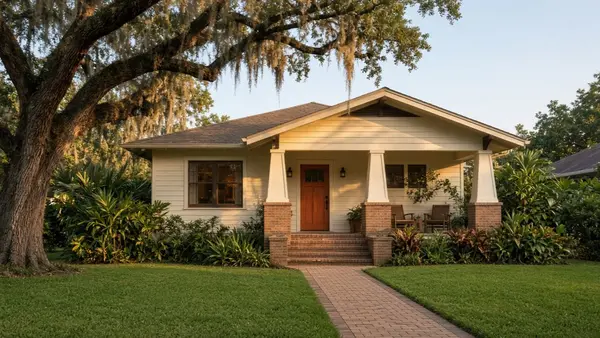
A bungalow in the Seminole Heights Residential District, Tampa, Florida. Photo by Ebyabe, via Wikimedia Commons, licensed under CC BY-SA 4.0 (https://creativecommons.org/licenses/by-sa/4.0/). Cropped, with title overlay and millage callout.
Seminole Heights Property Taxes 2026: What Buyers Should Expect
I live next door in Wellswood, and this is the season when 2026 tax bills are in people’s hands. I’ve already written a county-wide guide to 2026 Tampa Bay property taxes for due dates, discounts, and the payment calendar. I’m not going to repeat those dates here. This post is a different question: what should a Seminole Heights buyer expect? If you’re also trying to understand the house itself, start with my guide to buying a bungalow in Seminole Heights.
This is general information, not tax advice. Confirm the numbers for a specific address with the Hillsborough County Property Appraiser, the Tax Collector, or a tax professional.
Tampa’s 2026 millage rate, and how a bill is calculated
Seminole Heights is in the City of Tampa, so the millage that applies is the City of Tampa total, not the unincorporated Hillsborough rate.
The Hillsborough County Property Appraiser’s final 2026 millage table lists a City of Tampa total of 19.7353 mills. That total is made up of countywide, library, school, city, port, transit, Children’s Board, and Southwest Florida Water Management District levies. The same table is posted on the Property Appraiser’s Truth in Millage page. Taxing authorities set the rates. The Property Appraiser does not.
A mill is a rate, not a flat fee. The Hillsborough County Tax Collector explains that one mill equals $1 of tax for every $1,000 of taxable value. So the ad valorem (value-based) tax is taxable value ÷ 1,000 × the millage rate.
The Property Appraiser’s Truth in Millage FAQ is also a plain way to keep the three values straight:
- Market value (also called just value) is the Property Appraiser’s estimate of what the property would likely sell for in an open market, as of January 1.
- Assessed value may be lower than market value if a cap, such as Save Our Homes, applies.
- Taxable value is the assessed value minus any exemptions that apply to that taxing authority.
The 2026 TRIM notice guide notes that assessed and taxable values can differ among county, school, municipal, and other taxing authorities, because some exemptions and assessment reductions apply only to certain levies. That’s why a single “taxable value × 19.7353” figure is only a starting illustration, not a finished bill.
An illustrative example (not a real house, and not a typical price)
This example uses only the official 2026 City of Tampa total millage of 19.7353. It is labeled as an example on purpose. It is not an estimate for any Seminole Heights address, and it is not based on a median sale price.
Suppose a home had a taxable value of $400,000, and that one taxable value applied to the whole 19.7353 millage total:
$400,000 ÷ 1,000 × 19.7353 = $7,894.12 in ad valorem tax.
In real life, the math can split. Homestead exemptions, if you qualify, reduce taxable value, and the additional homestead exemption does not apply to school taxes. Non-ad valorem assessments, which I cover below, are added on the tax bill and are not based on that millage formula. Use the Property Appraiser’s tools on the actual folio, then confirm with the Property Appraiser, the Tax Collector, or a tax professional.
You can browse homes for sale in Seminole Heights and get oriented on my Seminole Heights overview, plus the Old, South, and Southeast Seminole Heights pages. The tax math still has to be done address by address.
Why a buyer’s bill can differ from the seller’s
This is the part I hear about most often, especially when a longtime owner has been in the same bungalow for years.
The Property Appraiser’s Save Our Homes page says that once a property is conveyed to a new owner, it is raised to full market value on January 1 of the following year. Even if the previous owner had a homestead exemption, “the limitation, just like the exemption, expires January 1 of the year following a change of ownership.” The new owner must apply for and receive homestead exemption.
The Truth in Millage page adds two practical notes for buyers. When you purchase a home from someone who has had a “capped” value, that capped value remains in effect only for the year of purchase. You may pay a pro-rated portion of the seller’s taxes at closing, but “the next year’s assessment will be at market value.” The 2026 TRIM notice guide tells new homeowners the same thing in plainer words: your property taxes may be much higher than the prior owner’s, and when ownership changes, the property is generally reassessed at market value for the following assessment year.
If you already have a Florida homestead and you’re moving, you may be able to transfer, or “port,” all or a portion of your Save Our Homes cap to a new homestead. The Property Appraiser’s homestead page describes portability and links a separate application. I’m not going to walk through portability math here, because it depends on your situation. Ask the Property Appraiser about it when you apply.
Homestead filing, and a way to estimate
Homestead is not automatic, and it does not travel with the deed.
The Property Appraiser’s Homestead & Other Exemptions page says the owner must have legal or beneficial title by January 1 of the year of the application, and must reside on the property as a permanent residence as of January 1. The statutory filing deadline is March 1. If March 1 falls on a weekend or legal holiday, it extends to the next business day. Applications are taken year-round, and late-filed applications may be taken up to the 25th day after the yearly Notice of Proposed Property Taxes (TRIM) is mailed, which is typically in August. After that, the Property Appraiser cannot accept an application for that calendar year.
On the benefit itself, that same page describes a first $25,000 exemption and an additional homestead exemption that does not include a benefit on the school tax. The 2026 TRIM notice guide says the first $25,000 generally applies to all millage rates, and an additional homestead exemption does not apply to school taxes. Confirm the current dollar amounts and your eligibility with the Property Appraiser. I also walk through homestead in my Florida homestead exemption guide, and you can try my homestead savings calculator. Those are helpers, not a ruling on your bill.
There is an official estimator. The Property Appraiser’s Tax Estimator lets you look up a property by folio, address, or owner and estimate school and non-school taxes using current millage data. The office’s own notice is important: it is an estimate only. Final taxes may differ based on exemptions, caps, taxing authority decisions, non-ad valorem assessments, and other factors. The 2026 TRIM guide also encourages buyers to use HCPA’s online tools before purchasing.
If you’re comparing a payment picture, my mortgage calculator can help you look at a monthly number. It cannot replace the Property Appraiser’s estimate or a conversation with a lender or tax professional, and I’m not giving lending or tax advice. If you already own a home and want a sense of value, you can start a home valuation.
Other charges on the tax bill
The tax bill is not only millage times taxable value.
The Tax Collector explains that non-ad valorem assessments are based on the benefit they provide to specific parcels, and that the local governing board — not the Property Appraiser — prepares that roll. The Tax Estimator’s notice also flags that final taxes may differ because of non-ad valorem assessments.
For a City of Tampa property, one common example is stormwater. The city’s Stormwater Utility Assessment information describes two annual non-ad valorem assessments, both paid as part of the property tax bill:
- A Stormwater Service Assessment for operations and maintenance. The city’s information sheet lists the current rate at $82.00 per ESU (Equivalent Stormwater Unit). A City of Tampa resolution for the fiscal year beginning October 1, 2026 adopts that same $82.00-per-ESU service rate and certifies the roll to the Tax Collector. The city says all developed parcels in Tampa that use the city’s stormwater system are subject to the service assessment.
- A Stormwater Improvement Assessment for capital improvements in the Central and Lower Basin Improvement Area. The information sheet lists that rate at $89.55 per ESU annually, scheduled to end in 2045. Only parcels in that improvement area are charged this second assessment.
Not every Seminole Heights parcel will have the same stormwater line. Check the bill or ask the city or the Tax Collector about the address. Other non-ad valorem charges can appear too. I’m not listing amounts I haven’t confirmed for City of Tampa tax bills.
If the house is historic, a tax exemption may be available
Being in the Seminole Heights Historic District does not, by itself, change the millage rate. There is, though, a separate program that can matter if you’re planning a qualifying rehabilitation.
The City of Tampa’s Historic Preservation Programs page and its Historic Property Ad Valorem Tax Exemption Program overview describe an exemption on a portion of the ad valorem taxes levied by the City of Tampa and Hillsborough County, for a period of up to ten years. It is authorized by City Ordinance No. 93-137, as amended, and section 196.1997, Florida Statutes.
It is not automatic. The city’s overview says applicants must receive Part I pre-rehabilitation approval before starting demolition, construction, or alterations; spend a minimum of $10,000; and meet the historic-status rules (the overview lists designated local landmarks and contributing buildings in a local or National Register historic district). After the work is completed, Part II is reviewed, and the owner must enter into a covenant. City Council and the Hillsborough County Board of County Commissioners consider granting the exemption. The city’s Historic Preservation staff can be reached at (813) 274-3100, Option 3.
I’m not advising anyone to count on this exemption, and I’m not saying it will apply to a particular bungalow. If a renovation is part of your plan, ask the city and the Property Appraiser. For the buyer-side historic-district rules on exterior changes, see the bungalow buying guide.
If you’d like a local guide
If you want to talk through a Seminole Heights house and the tax questions that come with it, book a time with me. I’ll help you look at the listing, the neighborhood, and the official sources — and I’ll remind you to confirm the numbers with the Property Appraiser or a tax professional. The singing is optional.
By the Numbers
- The City of Tampa’s 2026 total millage rate is 19.7353.
- One mill equals $1 of tax for every $1,000 of taxable value.
- Illustrative example only (not a real house, and not a typical price): $400,000 taxable value ÷ 1,000 × 19.7353 = $7,894.12 in ad valorem tax.
- A first $25,000 homestead exemption generally applies to all millage rates; an additional homestead exemption does not apply to school taxes. Confirm current dollar amounts and eligibility with the Property Appraiser.
- The statutory homestead filing deadline is March 1, and you generally need title and permanent residence as of January 1 of that year.
- Stormwater Service Assessment: $82.00 per ESU (Equivalent Stormwater Unit).
- Stormwater Improvement Assessment, for parcels in the Central and Lower Basin Improvement Area only: $89.55 per ESU annually, scheduled to end in 2045.
- The city’s historic property ad valorem tax exemption can apply to a qualifying, pre-approved rehabilitation with a minimum spend of $10,000, for a period of up to ten years. It is not automatic.
The Bottom Line
Frequently Asked Questions
What should a Seminole Heights buyer expect for 2026 property taxes?
Expect the City of Tampa’s 2026 total millage of 19.7353 to apply, but don’t treat the seller’s current bill as your future bill. After a sale, the assessment is generally reset to market value on the following January 1, and the seller’s homestead and Save Our Homes cap expire. Confirm the parcel with the Property Appraiser.
Why can my bill be higher than the seller’s?
If the seller had homestead and a Save Our Homes cap, their assessed value may have been well below market value. The Property Appraiser says that cap and exemption expire on January 1 of the year after a change of ownership, and the property is raised to full market value. You may also pay a pro-rated share of the seller’s taxes at closing for the year of purchase.
How is the tax bill calculated?
Start with market (just) value as of January 1, then assessed value, then subtract any exemptions that apply to get taxable value. Each taxing authority’s millage rate is applied to taxable value. One mill equals $1 of tax per $1,000 of taxable value. Non-ad valorem assessments can be added on the bill.
When do I file for homestead in Hillsborough County?
The statutory filing deadline is March 1, and you generally need title and permanent residence as of January 1 of that year. The Property Appraiser also describes a limited late-file window after the TRIM notice is mailed. Confirm dates and eligibility with their office.
Is there an official way to estimate taxes on a Seminole Heights house?
Yes. Use the Property Appraiser’s Tax Estimator on the folio or address. It is an estimate only. You can also look at my homestead savings calculator as a learning tool, then confirm with the Property Appraiser or a tax professional.
What is portability, and should I ask about it?
Portability is the transfer of all or a portion of a Save Our Homes cap to a new Florida homestead. It takes a separate application, usually when you file for homestead on the new home. Ask the Property Appraiser about your situation. I’m not giving tax advice on whether or how much you can port.
Are stormwater or other extra charges on the tax bill?
They can be. In Tampa, stormwater service and, for some parcels, stormwater improvement assessments are non-ad valorem charges collected on the property tax bill. Amounts depend on the parcel. Check the bill and confirm with the city or the Tax Collector.
Does the historic district automatically lower my taxes?
No. The local historic district does not change the millage by itself. The city does offer a historic property ad valorem tax exemption for a qualifying, pre-approved rehabilitation, on a portion of City of Tampa and Hillsborough County taxes, for up to ten years. Eligibility and approval are decided by the city and the county, not by this post.
- Hillsborough County Property Appraiser (https://www.hcpafl.org/): official source for assessments, exemptions, and confirming numbers for a specific address
- Hillsborough County Property Appraiser, final 2026 millage table (https://www.hcpafl.org/Portals/HCPAFL/pdfs/2026FinalMillage.pdf): City of Tampa total millage of 19.7353
- Hillsborough County Property Appraiser, Truth in Millage (https://www.hcpafl.org/property-info/truth-in-millage): millage table posting and FAQ on market, assessed, and taxable value, plus buyer notes on capped value after a sale
- Hillsborough County Tax Collector (https://www.hillstaxfl.gov/): tax bills and confirming non-ad valorem charges
- Hillsborough County Tax Collector, understanding your tax notice (tangible) (https://www.hillstaxfl.gov/taxes/tangible-property-tax/understanding-your-tax-notice/): one mill equals $1 of tax for every $1,000 of taxable value
- Hillsborough County Tax Collector, understanding your tax notice (real estate) (https://www.hillstaxfl.gov/taxes/real-estate-tax/understanding-your-tax-notice/): non-ad valorem assessments
- Hillsborough County Property Appraiser, 2026 TRIM notice guide (https://www.hcpafl.org/portals/hcpafl/pdfs/Hillsborough_County_2026_TRIM_Guide.pdf): homestead exemption wording, assessed vs. taxable value by taxing authority, and that a new owner’s taxes may be higher than the prior owner’s
- Hillsborough County Property Appraiser, Save Our Homes (https://www.hcpafl.org/property-info/save-our-homes): assessment is raised to full market value on January 1 of the year after a change of ownership
- Hillsborough County Property Appraiser, Homestead & Other Exemptions (https://www.hcpafl.org/property-info/homestead-other-info): homestead eligibility, March 1 filing deadline, late-file window, and portability
- Hillsborough County Property Appraiser, Tax Estimator (https://data.hillspafl.gov/tax-estimator): official estimate of school and non-school taxes by folio or address
- City of Tampa, Stormwater Utility Assessment information (https://www.tampa.gov/sites/default/files/document/2026/stormwater-utility-assessment-information-ada.pdf): Stormwater Service Assessment of $82.00 per ESU and Stormwater Improvement Assessment of $89.55 per ESU
- City of Tampa resolution for the fiscal year beginning October 1, 2026 (https://docs.meetings.tampamonitor.com/2026-08-06/meeting-2880/25519/ressolution-to-adopt-sw-service-assessment-roll.pdf): adopts the $82.00-per-ESU stormwater service rate and certifies the roll
- City of Tampa, Historic Preservation Programs (https://www.tampa.gov/historic-preservation/programs): historic property ad valorem tax exemption program
- City of Tampa, Historic Property Ad Valorem Tax Exemption Program overview (https://www.tampa.gov/sites/default/files/document/2026/ad_val_tax_overview_2023_historic-ad-valorem-tax_ada.pdf): pre-approval, $10,000 minimum spend, covenant, and up-to-ten-year exemption on a portion of City of Tampa and Hillsborough County taxes
- City of Tampa, Historic Preservation (https://www.tampa.gov/historic-preservation): staff contact at (813) 274-3100, Option 3
Leanna Tillman, Realtor® with Y Realty, serving Tampa, St. Petersburg, Seminole Heights, Wesley Chapel, and Apollo Beach.
📱 (813) 334-6560 | 📧 singingrealtortampa@gmail.com
License: SL3645393
Curious what's on the market? Click here → https://singingrealtortampa.com/listing
FROM OUR BLOG

South Tampa Access Map: What Nearby Neighborhoods Really Cost
South Tampa Access Map: What Nearby Neighborhoods Really Cost By Leanna Tillman, Realtor® | Tampa Bay Real Estate Quick Answer: Hyde Park's median home price hit $1.2 million in August 2026, and Davis Islands sits even higher at $1.56 million. Head 15 to 45 minutes away and prices drop fast. Seminol

Buying a Bungalow in Seminole Heights: The 2026 Guide (Old, South & Southeast)
Header photo by Ebyabe, via Wikimedia Commons, licensed under CC BY-SA 4.0. Cropped, with title overlay. Buying a Bungalow in Seminole Heights: The 2026 Guide (Old, South & Southeast) By Leanna Tillman, Realtor® | Tampa Bay Real Estate Quick Answer: I live next door in Wellswood, and the short versi

2026 Tampa Bay Holiday Guide: Christmas Lights, Markets & Events
Tampa Bay Local Guide | November 2026 Looking for the best holiday events in Tampa Bay in 2026? From Christmas lights and waterfront celebrations to holiday markets, ice skating and free family activities, Tampa Bay is full of festive ways to celebrate. Whether you're a longtime Tampa resident, visi