
Moving to Florida? Already living in Tampa Bay but thinking about buying your first home? Florida's newly approved Amendment 3 could change when you become eligible for a larger homestead property tax exemption.
But here's what many homebuyers don't realize: when you establish Florida residency and when you purchase a home are two different things. Both can affect your property tax timeline.
Let's break down what changed, look at 10 real-world buyer scenarios, and see how you can estimate potential savings before making your next move.
Wondering what this means for you?
Try my free Florida Homestead Savings Calculator. Compare your residency date, expected purchase year, and estimated property tax savings.
Explore the Free CalculatorWhat changed with Florida Amendment 3?
Florida voters approved Amendment 3 on November 3, 2026. The amendment expands the homestead exemption that applies to qualifying non-school property taxes.
2027: The expanded exemption increases to $150,000 for eligible homesteads.
2028: The expanded exemption increases to $250,000.
2029 onward: Inflation adjustments begin, subject to applicable rules.
These are exemptions from taxable assessed value, not payments or guaranteed tax savings. The actual financial impact depends on your home's assessed value, the applicable tax rates, and eligibility.
School property taxes and non-ad valorem assessments are not eliminated by the expanded exemption.
The two dates that matter most
Before looking at potential savings, understand these two important dates.
December 31, 2026
This is the residency cutoff included in Amendment 3. If you had already established permanent Florida residency by this date, you may qualify for the expanded exemption in your first eligible homestead year. You do not necessarily need to own a home by this date.
January 1 of your homestead tax year
Generally, you must own and occupy your qualifying permanent residence as of January 1 to receive the homestead exemption for that tax year, subject to filing and eligibility requirements.
If you establish Florida residency after December 31, 2026, Amendment 3 generally provides the existing exemption during your first four qualifying homestead years. The expanded exemption begins in your fifth qualifying homestead year, subject to the amendment's constitutional qualification and applicable implementation rules.
10 Florida homebuyer scenarios explained
Everyone's moving timeline is different. These examples show how the timing could work for buyers moving to Tampa Bay, people who already live here, and homeowners considering a move.
All scenarios assume the buyer meets the applicable residency and homestead requirements, applies properly, and remains eligible. Years shown are illustrative.
Already a Florida resident by December 31, 2026?
1. You already own your Florida primary residence
You own and occupy your qualifying Florida home by the end of 2026.
Potential expanded exemption: 2027, assuming you qualify for that tax year.
2. You already live in Florida but buy in 2027
You've established Florida residency and decide to purchase a primary residence during 2027.
First potential expanded exemption: 2028.
3. You move to Florida in 2026, rent first, and purchase in 2027
Maybe you want to explore Seminole Heights, South Tampa, or Carrollwood before buying. Renting first does not automatically disqualify you from the earlier residency category.
First potential expanded exemption: 2028, if you established permanent residency by the 2026 cutoff and qualify for homestead.
4. Your planned December closing moves to January
You're already a Florida resident, but your December 2026 closing moves into January 2027. That could shift your first homestead tax year.
First potential expanded exemption: 2028 rather than 2027.
Moving to Florida in 2027 or later?
Under Amendment 3's new-resident provision, your first four qualifying homestead years generally receive the smaller exemption, with the expanded amount beginning in year five.
5. You move to Florida and buy in 2027
You move into your qualifying primary home during 2027.
First homestead year: 2028
First potential expanded year: 2032
6. You move to Florida and buy in 2028
You establish residency and move into your qualifying home during 2028.
First homestead year: 2029
First potential expanded year: 2033
7. You relocate in 2027, rent for two years, and purchase in 2029
Renting gives you time to explore Tampa Bay, but those rental years do not count as qualifying homestead exemption years.
First homestead year: 2030
First potential expanded year: 2034
What would your timeline look like?
Change the year you establish residency, the year you purchase, and the home's assessed value. See how those choices affect your illustrative homestead savings.
Calculate Your Potential SavingsOther situations worth considering
8. You're moving from one Florida home to another
If you're already a qualifying Florida resident and purchase a different primary residence, your residency history may support earlier access to the expanded exemption. Ask your property appraiser about homestead eligibility and any Save Our Homes portability benefits.
9. You're purchasing a vacation home or rental property
The expanded homestead exemption generally does not apply to a second home or investment property. Amendment 3 also changes the assessment growth cap for certain non-homestead properties, but that's separate from homestead savings.
10. You purchase a lower-assessed-value home
Your potential savings may be smaller than those of someone purchasing a higher-assessed-value property. For example, a home assessed at $200,000 cannot benefit from the entire $250,000 non-school exemption. The exemption is limited by the applicable taxable assessed value.
How much money could you actually save?
Let's use a simplified Tampa example.
Illustrative assessed home value: $500,000
Modeled existing non-school exemption: $50,000
Expanded 2028 exemption: $250,000
Additional exempt value: $200,000
Illustrative additional annual savings: approximately $2,680
This example applies an illustrative 2026 City of Tampa non-school rate of 13.4013 mills to the additional $200,000 in exempt value.
It is not a prediction of a future tax bill. Assessed value is not necessarily the purchase price, and future tax rates, inflation, assessment limitations, and eligibility can produce different results.
Frequently asked questions
Do I have to buy a Florida home by December 31, 2026?
Not necessarily. Amendment 3's cutoff relates to Florida residency, not a universal home purchase deadline. You may be able to establish permanent Florida residency while renting and purchase a qualifying primary residence later. Residency must be established under applicable law.
What if I move to Florida after December 31, 2026?
Under the amendment's new-resident provision, the expanded exemption generally begins in your fifth qualifying homestead exemption year, rather than your fifth calendar year living in Florida.
Does the $250,000 exemption mean I save $250,000?
No. It reduces the assessed value subject to qualifying non-school property taxes. Your actual dollar savings depend on the property and applicable tax rates.
Can I calculate savings before choosing a home?
Yes. You can compare different purchase years, assessed values, and available taxing areas using the calculator. The results are estimates, not official tax quotes.
The bottom line for Tampa Bay buyers
Whether you're relocating to Tampa, renting before purchasing, or considering a move within Florida, understanding your timeline is an important part of planning.
Start by separating your Florida residency date from your first qualifying homestead year. Then compare possible purchase timelines and estimated savings.
Ready to run your own scenario?
Explore how different moving and buying dates could affect your estimated Florida homestead savings.
Try the Free Florida Savings CalculatorAnd if you're planning a move to Tampa Bay, I'm happy to help you explore neighborhoods, compare homes, and put together a homebuying timeline that works for you.
Leanna Tillman, Realtor®
Singing Realtor Tampa | Y Realty
Tampa Bay, Florida
Sources and further reading
Florida Division of Elections — Amendment 3
Ballotpedia — Florida Amendment 3 (2026)
Florida TaxWatch — Property Tax Resource Center
Important Disclaimer: Tax and Financial Information
I am a licensed Florida real estate professional, not a licensed tax professional, certified public accountant, or tax attorney. The information, timelines, scenarios, calculator results, and dollar amounts presented in this article are provided for general educational and illustrative purposes only. They are not tax, legal, or financial advice.
All examples are hypothetical and based on stated assumptions. Actual property taxes, exemptions, eligibility, and savings will vary based on individual circumstances, assessed values, taxing jurisdictions, applicable law, and future tax rates.
For calculations specific to your circumstances, please consult a licensed tax professional or CPA. Confirm homestead eligibility, residency requirements, and applicable exemption rules with your county property appraiser. Do not make residency, purchasing, or financial decisions solely on the examples provided here.
FROM OUR BLOG
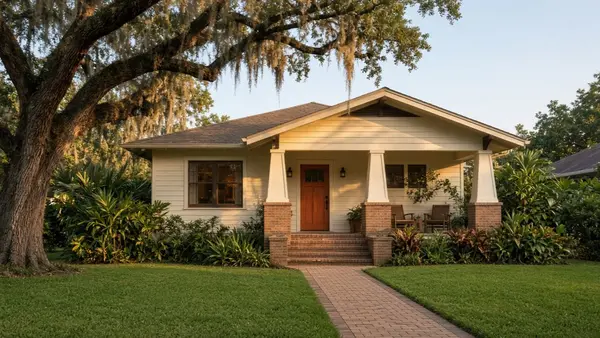

South Tampa Access Map: What Nearby Neighborhoods Really Cost
South Tampa Access Map: What Nearby Neighborhoods Really Cost By Leanna Tillman, Realtor® | Tampa Bay Real Estate Quick Answer: Hyde Park's median home price hit $1.2 million in August 2026, and Davis Islands sits even higher at $1.56 million. Head 15 to 45 minutes away and prices drop fast. Seminol
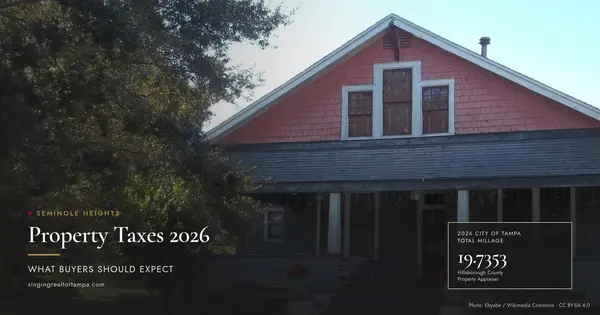
Seminole Heights Property Taxes 2026: What Buyers Should Expect
A bungalow in the Seminole Heights Residential District, Tampa, Florida. Photo by Ebyabe, via Wikimedia Commons, licensed under CC BY-SA 4.0 (https://creativecommons.org/licenses/by-sa/4.0/). Cropped, with title overlay and millage callout. Seminole Heights Property Taxes 2026: What Buyers Should Ex
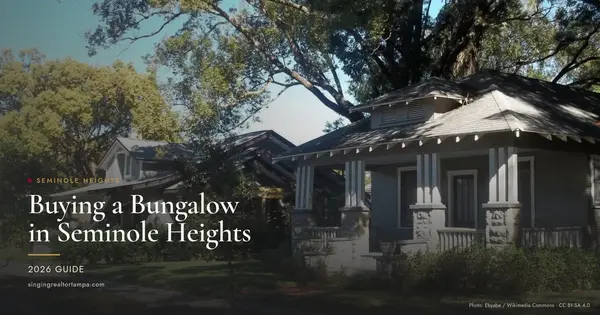
Buying a Bungalow in Seminole Heights: The 2026 Guide (Old, South & Southeast)
Header photo by Ebyabe, via Wikimedia Commons, licensed under CC BY-SA 4.0. Cropped, with title overlay. Buying a Bungalow in Seminole Heights: The 2026 Guide (Old, South & Southeast) By Leanna Tillman, Realtor® | Tampa Bay Real Estate Quick Answer: I live next door in Wellswood, and the short versi